
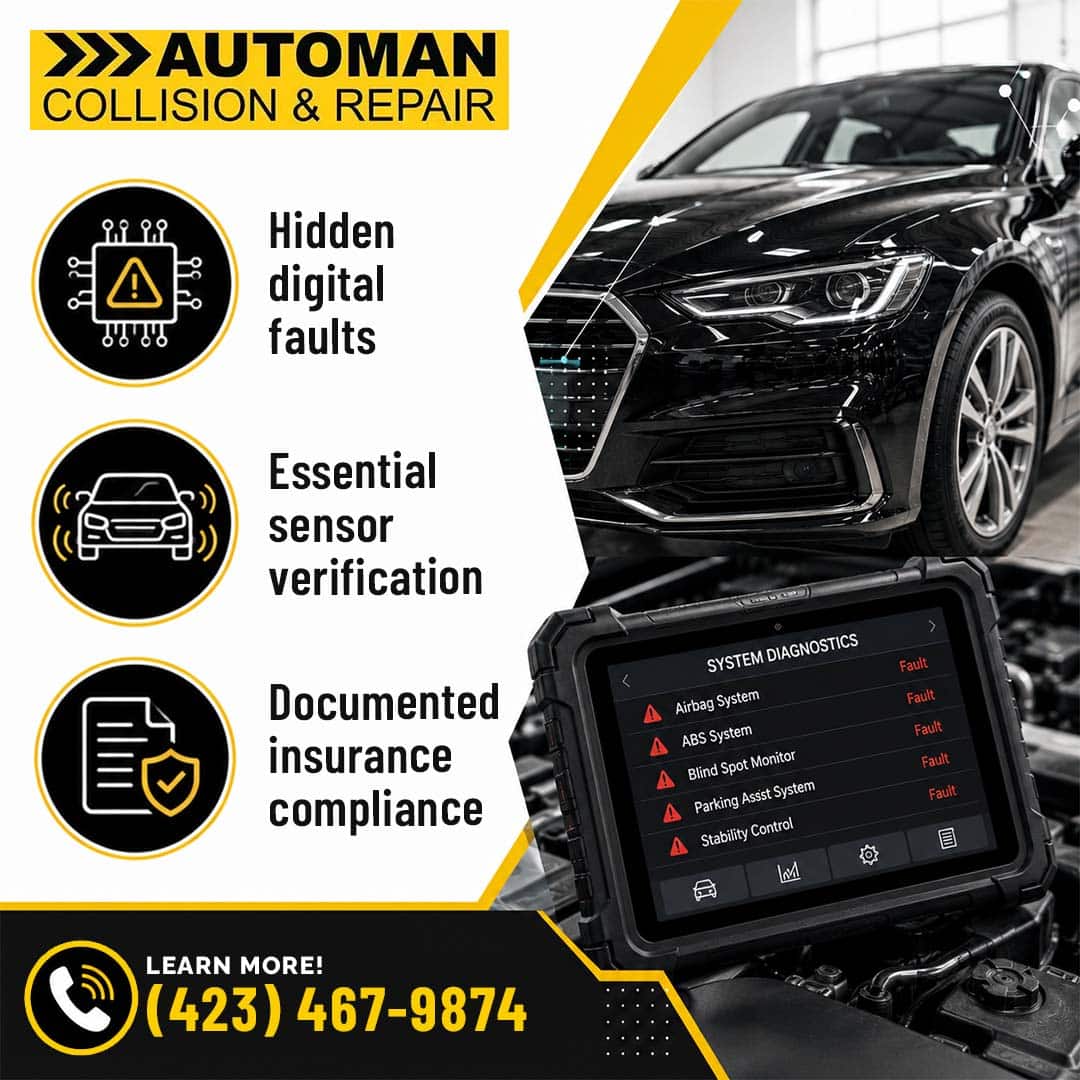
A diagnostic scan reads a vehicle’s computer systems for fault codes, while an ADAS calibration recalibrates sensors and cameras to their exact factory specifications. A scan finds the problem. A calibration fixes the alignment issue causing it. Both matter for collision repair services, but they are not interchangeable steps. We perform both steps on every applicable repair at Automan Collision & Repair, LLC, because a scan alone does not guarantee that safety systems work correctly.
Key Takeaways:
- A diagnostic scan identifies fault codes in a vehicle’s onboard systems.
- An ADAS calibration realigns cameras, radar, and sensors to precise angles.
- A scan can run without a calibration, but a calibration usually follows a scan.
- Skipping calibration can leave safety features like automatic braking inactive or inaccurate.
What Does a Diagnostic Scan Actually Check?
A diagnostic scan connects a tool to the vehicle’s data port and reads stored fault codes from each onboard module. It shows what is malfunctioning, such as a disconnected sensor or a camera that lost its signal after a collision. A scan does not fix anything. It only identifies where the problem sits.
This step should ideally be performed at any collision repair shop before and after bodywork. A pre-repair scan documents starting issues. A post-repair scan confirms the repair resolved them.
What Does an ADAS Calibration Involve?
An ADAS calibration adjusts a vehicle’s cameras, radar, and sensors so they point and read at the exact angle the manufacturer specifies. Technicians use targets, measurements, and specialized equipment to complete this process, often in a controlled shop environment or on a test drive.
Calibration is required whenever a part connected to ADAS is removed, replaced, or repositioned. Examples include windshield replacement, bumper repair, or realigning a mirror housing a blind spot camera.
How Do a Scan and a Calibration Work Together?
| Step | Purpose | When It Happens |
| Diagnostic Scan | Identifies fault codes and system errors | Before and after repair |
| ADAS Calibration | Realigns sensors to factory specifications | After parts are replaced or repositioned |
| Verification Scan | Confirms calibration resolved the fault codes | After calibration is complete |
A scan without a needed calibration can miss an alignment issue that only shows up when the system engages. A vehicle can pass a scan and still have a camera aimed a few degrees off, which is enough to affect automatic braking or lane detection.
Why Does This Distinction Matter for Insurance Claims?
Insurance appraisals increasingly separate these two line items because they involve different tools, time, and cost. Diagnostic scans now appear on almost 70% of repairable appraisals, up from 3.3% in 2017, while calibrations appear on more than 23% of appraisals, up from under 1% in the same period. The percentage of appraisals that include a calibration is growing at a faster rate than the percentage that include a scan, reflecting the rising number of vehicles equipped with ADAS features.
What Should You Ask Your Collision Repair Shop
Ask whether your vehicle needs a scan, a calibration, or both. Request documentation showing which fault codes were found and which calibrations were performed. A collision repair shop that explains this difference clearly is one that understands the full scope of a modern repair.
If your vehicle needs collision repair in Johnson City, TN, ask whether both scanning and calibration are included in the estimate. Automan Collision & Repair, LLC includes these steps as standard practice on every applicable repair.
Schedule Your Collision Repair Services Today
Our collision repair services come backed by over 30 years of experience and I-CAR Gold-Class Certification. Every estimate is free, with no obligation. Call us at (423) 467-9874 or email [email protected] to schedule your estimate with Automan Collision & Repair LLC.