
At Automan Collision & Repair, LLC, we know that being in a collision is stressful enough without having to wonder whether your vehicle is being fixed correctly. For more than 30 years, drivers throughout Johnson City and Northeast Tennessee have relied on us as their trusted collision repair center. We bring together I-CAR Gold Class-certified technicians, industry-leading equipment, and a process that prioritizes your safety as much as your vehicle’s appearance. We work with all insurance providers, handle the paperwork on your behalf, and do not return your vehicle until every system has been inspected and every repair meets manufacturer standards. When you bring your vehicle to us, you get a team that treats it like their own.
Key Takeaways
- Collision repair done correctly takes time because structural and safety system checks cannot be rushed.
- Certified technicians follow a multi-step repair process that goes well beyond replacing damaged panels.
- Skipping steps to speed up a repair can compromise airbag deployment, alignment, and frame integrity.
- A reputable collision repair shop will give you a clear timeline and update you as the work progresses.
- Collision repair services that include insurance coordination reduce delays caused by documentation and approvals.
How Long Does Collision Repair Actually Take?
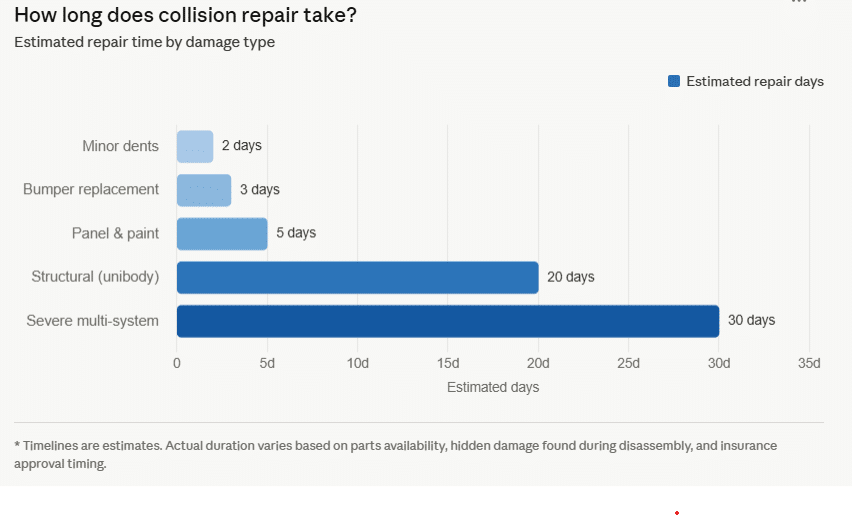
Collision repair timelines range from one day for minor damage to several weeks for structural or multi-system repairs.
The length of a repair depends on the extent of damage, parts availability, and whether hidden damage is discovered once disassembly begins. A rear bumper replacement on a sedan is a different job than repairing a unibody frame after a front-end collision.
Many drivers expect collision repair to move as fast as an oil change. That expectation can lead to frustration when a shop takes extra time to do the job correctly. Understanding the repair process helps set realistic expectations and gives you confidence that your vehicle is being restored the right way.
What Does the Collision Repair Process Actually Involve?
A complete collision repair includes damage assessment, structural repair, mechanical checks, body work, paint, and a final safety inspection.
Each of these steps builds on the one before it. Skipping or rushing any stage creates problems that may not show up immediately but affect vehicle safety and performance over time.
Here is how the process breaks down at a qualified collision repair shop:
1. Damage Assessment: A technician at an auto body shop inspects visible and hidden damage. This includes checking the frame, steering components, and safety systems. For unibody vehicles, computerized measuring tools confirm whether the structure has shifted from factory specifications.
2. Insurance Documentation: The shop works with your insurance provider to document damage and approve the repair scope. This step affects timelines, which is why a collision repair shop that handles insurance coordination directly saves you considerable time and stress.
3. Disassembly: Panels are removed to expose hidden damage. It is common for additional damage to appear at this stage, particularly in moderate to severe collisions. This discovery requires supplemental documentation before repair work continues.
4. Structural Repair: Frame straightening or sectioning is performed using manufacturer specifications. This is one of the most time-sensitive steps because every measurement must meet factory tolerances before body work begins.
5. Body Work and Refinishing: Panels are repaired or replaced, filled, sanded, primed, and painted. Color matching requires skill and time to produce a factory-quality finish.
6. Mechanical and Safety System Checks: Alignment, mechanical components, airbag sensors, and electronic systems are tested. Vehicles with advanced driver assistance systems (ADAS) require calibration after certain repairs.
7. Final Inspection and Delivery: A quality check confirms the repair meets standards before your vehicle is returned to you.
Why Safety Cannot Be Traded for Speed
Rushing collision repair creates risks that are not visible at pickup but affect vehicle behavior and crash protection.
Airbags, seat belts, and crumple zones rely on a properly aligned vehicle structure to protect occupants during a collision. Even minor frame damage can alter how a vehicle responds in a future crash, potentially redirecting impact forces toward the passenger compartment.
Three specific examples show where rushed repairs create real problems:
- Airbag systems: Sensors that are not properly reset or recalibrated after a collision may fail to deploy in a future crash or deploy unexpectedly while driving.
- Frame tolerances: A frame straightened by eye rather than by computerized measurement may look correct, but sit outside factory tolerances. This affects alignment, tire wear, and crash energy distribution.
- ADAS calibration: Vehicles with lane departure warning, automatic emergency braking, or blind-spot monitoring require camera and radar recalibration after certain repairs. Skipping this step disables the system without triggering a warning light.
What Slows Down a Collision Repair?
The most common delays in collision repair are parts availability, hidden damage discovered during disassembly, and insurance approval timelines.
Understanding these factors helps you have a realistic conversation with your collision repair shop and avoid pressure that could lead to a compromised result.
Parts availability has become a more common delay in recent years. Vehicles with proprietary components, newer model years, or imported parts may require longer lead times. A shop cannot control how quickly a manufacturer ships a part. Staying in contact with your shop during this stage helps you track progress and plan around the delay without added stress.
Hidden damage is discovered once panels are removed. A door that looked dented on the surface may reveal a bent door frame underneath. A technician must stop, document, and get supplemental approval before continuing. Skipping this step to save time means the hidden damage goes unrepaired. At a qualified collision repair shop, this discovery is treated as a necessary part of the process, not an inconvenience.
Insurance approvals add time when supplemental claims are filed mid-repair. A collision repair shop that works directly with insurance providers and handles documentation on your behalf reduces these delays considerably. Shops with established insurance relationships move through the approval process faster than those that place that burden on the vehicle owner.
According to I-CAR, blueprinting, the process of identifying all damage before repairs begin, eliminates problems that arise from finding additional damage mid-repair, which can interrupt and delay the repair process.
How to Know If Your Repair Is Being Done Right
A quality collision repair shop communicates clearly, provides written documentation, and does not return your vehicle until every system has been checked.
Here are the signs that a collision repair shop is prioritizing quality over speed:
- They provide a written estimate before work begins.
- They contact you if additional damage is discovered.
- They confirm alignment checks are part of the process.
- They recalibrate ADAS systems when required by the repair.
- They offer a warranty or satisfaction policy on completed work.
- They work directly with your insurance provider.
If a shop pressures you to pick up your vehicle before you feel confident that the work is complete, that is a signal worth paying attention to. Your satisfaction and your vehicle’s safety are the correct benchmarks, not a fast turnaround.
What to Ask a Collision Repair Shop Before You Commit
Ask whether the shop is I-CAR certified, whether ADAS recalibration is included, and what their process is for communicating hidden damage.
These three questions reveal whether a shop is set up to repair your vehicle correctly. A shop that cannot answer them clearly may not have the training or equipment the job requires.
Additional questions worth asking:
- Do you work directly with my insurance provider?
- Will you provide a written estimate and update it if new damage is found?
- What is your process for structural measurement and frame straightening?
- Do you offer a warranty on repairs?
At a qualified auto body collision shop near you, these questions should be easy to answer. Hesitation or vague responses are a reason to look elsewhere.
Collision Repair Services in Johnson City, TN
Automan Collision & Repair, LLC in Johnson City, TN, provides collision repair services for both unibody and body-on-frame vehicles, with I-CAR Gold Class-certified technicians and advanced equipment on-site.
When you bring your vehicle to our shop, you are working with technicians who meet the industry’s highest training standards through I-CAR Gold Class certification. Every repair we complete follows a documented process tied to manufacturer specifications.
We have served Johnson City and nearby areas in Northeast Tennessee for over 30 years. Our shop is a Reader’s Choice Award winner, locally and family-owned, and we work with all insurance providers to handle paperwork directly.
Whether you need to repair collision damage from a minor fender bender or a significant structural impact, our process is built around returning your vehicle in the safest condition possible, not the fastest.
Our clients in Johnson City, TN, share their experience:
- “Our BMW X3 was hit in a parking lot while Christmas shopping in December. The front bumper had to be replaced, and we are new to the area. I read the reviews on Google, and Automan had great reviews. I called them up and had my estimate done. They communicated well with the insurance company and me. My car was repaired, and I am very happy with the results. The bumper lines up perfectly, and the paint match is absolutely spot on. I will always use Automan for any autobody work that I need in the future. “ – Angelo D.
- “Man! James is the absolute goat! My car was hit pretty bad, and within a little less than a month had it looking better than it did before! Had a few things to touch up on and James didn’t hesitate to fix it! You and ur team are amazing, man. I appreciate you all “ – Alvenga.
Get a Free Estimate for Collision Repair in Johnson City, TN
Do not let collision damage sit unaddressed. Hidden structural and mechanical issues develop over time and become more involved to correct.
We are your local collision repair shop serving Johnson City and nearby areas across Northeast Tennessee. Call us at (423) 467-9874 to schedule your free, no-obligation estimate.
Visit our website or email [email protected] to get started.
Your vehicle does not leave until you are satisfied with the result.