
At Automan Collision & Repair, LLC, we have spent over 30 years working on vehicles of every make, model, and structure type for drivers across Johnson City and nearby areas in Northeast Tennessee. One question we often hear is whether the type of vehicle structure affects how a repair is done, and why it matters. The answer is yes, and it affects everything from how damage spreads through your vehicle to how long the repair takes and what equipment is required to do it correctly. Our certified auto body technicians in Johnson City make sure that every structural repair we perform follows manufacturer specifications, not guesswork.
As a locally and family-owned shop, we believe drivers deserve to understand what is happening to their vehicle and why. This blog breaks down the difference between unibody and body-on-frame construction and explains what that difference means for your repair.
Key Takeaways
- Your vehicle’s structure type directly affects repair cost, time, and method. Knowing which type your vehicle has helps you ask the right questions at any auto body repair shop before work begins.
- Most modern passenger vehicles use unibody construction. Trucks and SUVs more often use body-on-frame construction. A qualified body shop near you should have the equipment and training to handle both correctly.
- I-CAR Gold Class-certified technicians have the training to repair both structures correctly. When comparing local auto body shops, active I-CAR certification is one of the most reliable indicators of repair quality.
- Incorrect structural repairs can compromise your vehicle’s safety systems, including crumple zones and airbag deployment. Auto body repair in Johnson City, TN, at Automan Collision & Repair follows manufacturer specifications on every structural repair.
- A free estimate from a qualified auto body repair shop helps you understand what structural repairs your vehicle actually needs. Never commit to repair work without a written assessment from a certified shop first.
What Is the Difference Between Unibody and Frame Construction?
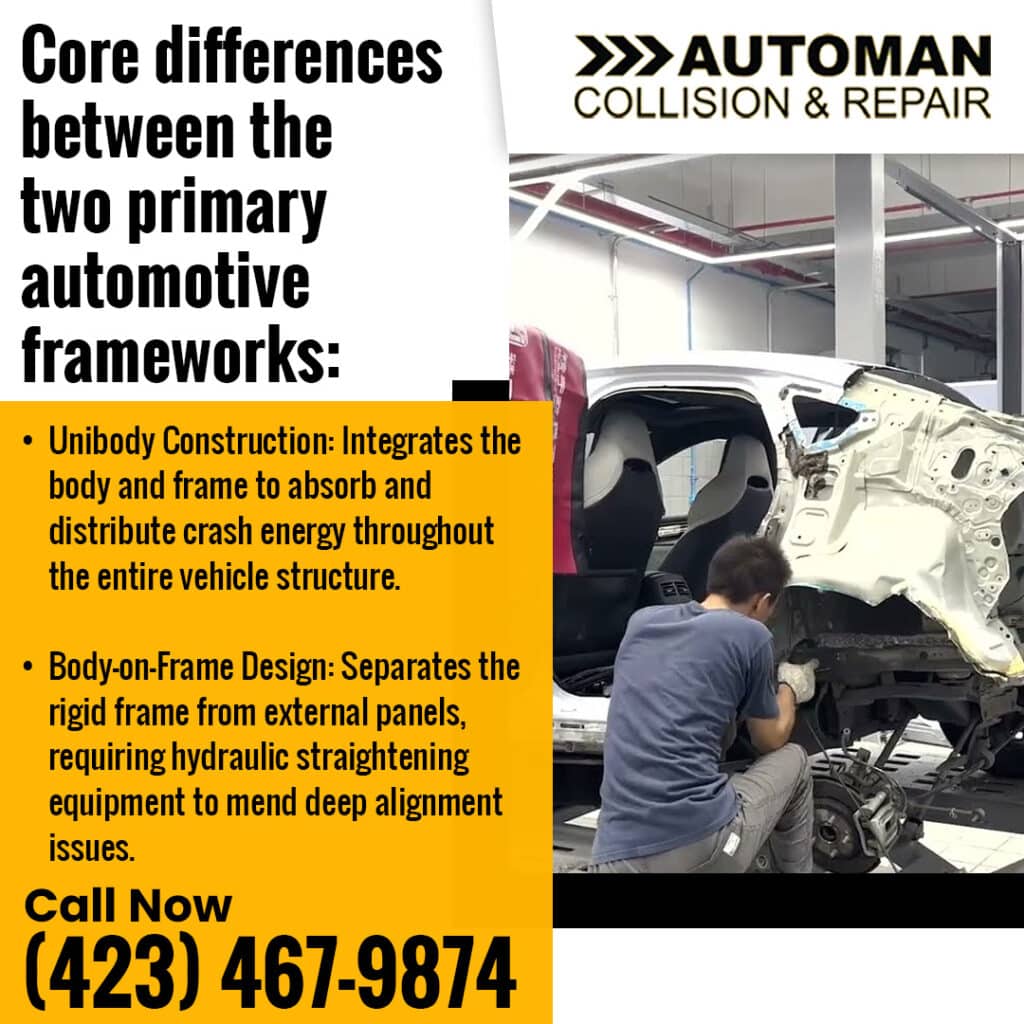
Unibody construction integrates the body and frame into one single structure. Body-on-frame construction uses a separate rigid frame onto which the body is mounted.
These are the two main structural designs used in vehicles today. Understanding which one your car has changes everything about how an auto body repair shop approaches collision damage.
Unibody vehicles include most sedans, hatchbacks, crossovers, and minivans. Body-on-frame vehicles include most full-size trucks, large SUVs, and commercial vans.
How Does Unibody Construction Affect Collision Repair?
Unibody damage requires precise measuring, sectioning, and welding because the entire structure absorbs and distributes impact energy.
In a unibody vehicle, the floor pan, pillars, roof rails, and fenders are all one connected piece. When one section bends or crumples in a collision, the damage spreads through the whole structure.
Repairing this type of damage correctly requires a frame straightening machine, factory measurements, and certified technicians who understand how the structure is supposed to behave in a future crash.
At Automan Collision & Repair in Johnson City, TN, our team uses advanced equipment to restore unibody vehicles to factory specifications before your car ever leaves the shop.
How Does Body-on-Frame Construction Affect Collision Repair?
Body-on-frame vehicles have a separate ladder-style frame, so body panels and the structural frame can often be repaired or replaced independently.
This separation makes some repairs more straightforward. If a bed panel on a pickup truck is damaged, it may be removable without affecting the frame underneath. However, frame damage on these vehicles is serious and still requires specialized equipment.
Bent or twisted frames on body-on-frame vehicles affect alignment, suspension geometry, and handling. A qualified auto body shop in Johnson City, TN, will use hydraulic frame straightening equipment to restore the frame to its original dimensions.
Unibody vs. Body-on-Frame: How Construction Type Affects Collision Repair
| Factor | Unibody | Body-on-Frame |
| Structure type | Integrated body and frame | Separate frame and body |
| Common vehicles | Sedans, crossovers, hatchbacks | Full-size trucks, large SUVs |
| Damage spread | Distributes throughout structure | Stays more localized |
| Repair approach | Measuring, sectioning, welding | Panel swap or frame straightening |
| Crumple zones | Built into body structure | Often in front/rear frame rails |
| Equipment needed | Frame machine, factory data | Hydraulic frame straightener |
| Certification needed | I-CAR or OEM training required | I-CAR or OEM training required |
Why Does Vehicle Structure Matter for Safety?
A structurally repaired vehicle must perform exactly as designed in a future crash. If the repair is incorrect, crumple zones may not absorb impact properly, and airbags may not deploy correctly.
A study based on IIHS crash test data found that drivers of vehicles rated good for structure were 70% less likely to die in a side-impact crash than drivers of vehicles rated poor.
Crumple zones are engineered sections of a vehicle designed to collapse in a controlled way during a crash. They redirect crash energy away from occupants. These zones are built into the unibody structure itself, which is why factory-correct repairs matter so much.
Local auto body shops that lack proper equipment or training may miss hidden structural damage entirely. That is why choosing I-CAR Gold Class certified auto body technicians in Johnson City matters for your safety, not just the appearance of your vehicle.
I-CAR (Inter-Industry Conference on Auto Collision Repair) is the national training organization that sets repair standards across the industry. Automan Collision & Repair holds I-CAR Gold Class certification, meaning our technicians meet those standards.
What Happens If Frame or Structural Damage Goes Unrepaired?
Unrepaired structural damage leads to alignment problems, uneven tire wear, compromised handling, and reduced crash protection.
Here are three specific examples of what can go wrong:
- A bent unibody frame rail causes the vehicle to pull to one side. Over time, tires wear unevenly, and suspension components fail earlier.
- A twisted body-on-frame chassis puts stress on the drivetrain and differential. This leads to vibration, noise, and mechanical wear.
- A repaired-but-not-straightened unibody structure may trigger airbag sensors incorrectly or delay deployment in a future impact.
Each of these outcomes is preventable. A qualified auto body repair shop with the right equipment and certified technicians can identify structural damage early, document it accurately, and restore your vehicle to the manufacturer’s specifications before any of these problems develop.
How Do Technicians Diagnose Structural Damage?
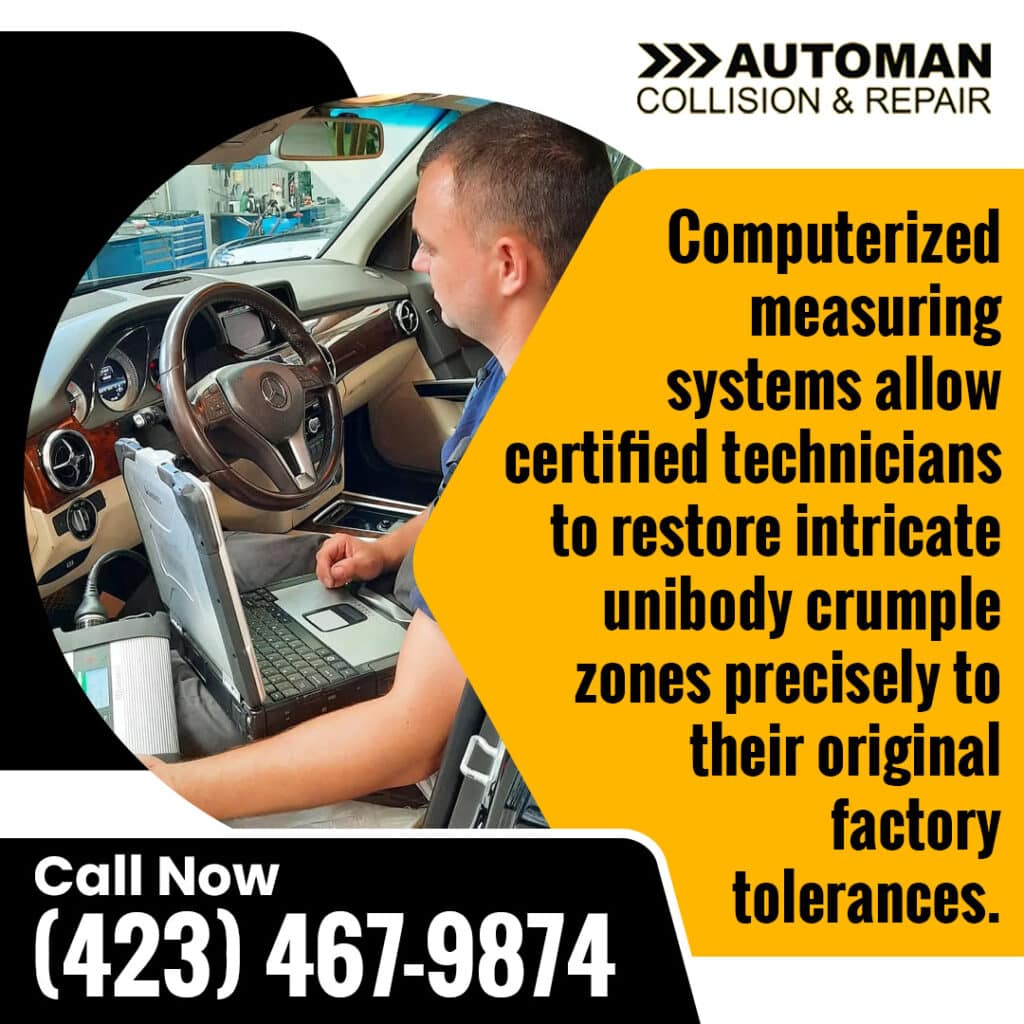
Technicians use computerized measuring systems and manufacturer repair data to identify structural damage that is not visible.
After a collision, even a moderate fender bender can cause structural misalignment that looks fine from the outside. The diagnostic process at a qualified auto body repair shop includes:
- Visual inspection of panels, joints, and seams for buckling or misalignment
- Frame measurement using a computerized system tied to factory tolerances
- Pull and straighten analysis to determine how much deformation occurred
Certified auto body technicians in Johnson City at Automan Collision & Repair use advanced equipment and factory data for every structural repair. This process applies to both unibody and body-on-frame vehicles.
Does Structure Type Affect How Long Repairs Take?
Yes. Unibody repairs often take longer because damage spreads through more of the vehicle and requires sectioning, welding, and multiple measurement checks.
Body-on-frame repairs can sometimes move faster when only the body panels are damaged, since those components can be replaced independently of the frame. However, frame straightening on either vehicle type adds time because each correction must be measured against factory specs before moving forward.
At Automan Collision & Repair, we work with all insurance providers and handle the paperwork so you do not experience delays in documentation. This helps move your repair forward as quickly as the work allows.
How to Choose the Right Auto Body Shop for Structural Repairs
Look for an auto body repair shop with I-CAR Gold Class certification, computerized measuring equipment, and experience with your specific vehicle type.
Not every body shop near you has the equipment or training to perform structural repairs correctly. Here is what to check:
- I-CAR Gold Class or OEM certification
- Frame measuring and straightening equipment on-site
- A clear written estimate before any work begins
- Insurance coordination to avoid out-of-pocket surprises
- A warranty or satisfaction policy on completed repairs
Certification matters because structural repairs are not visual work alone. A shop without proper training may straighten a frame to the eye but miss tolerances that affect how your vehicle handles or how its safety systems perform in a future crash. Ask any local auto body shop you are considering whether their technicians hold active I-CAR credentials and whether their equipment is calibrated to manufacturer specs.
At Automan Collision & Repair in Johnson City, TN, we have over 30 years of experience working on both unibody and body-on-frame vehicles. We are a Reader’s Choice Award winner, hold I-CAR Gold Class certification, and are locally and family-owned. Every vehicle that comes through our doors receives a free, no-obligation estimate before any work begins.
Whether you drive a crossover, a sedan, or a full-size truck, choosing the right auto body repair shop in Johnson City, TN, makes a measurable difference in the quality and safety of your repair. Choosing a shop based on price alone can leave you with a vehicle that looks repaired but is not structurally sound. At Automan, we back every repair with certified technicians, advanced equipment, and a satisfaction-first process that goes well beyond getting the job done on the surface.
Get a Free Structural Repair Estimate in Johnson City
If your vehicle has been in a collision, do not wait. Hidden structural damage gets more expensive to fix when left unaddressed.
Damage that looks minor from the outside can involve bent frame rails, shifted body panels, or misaligned mounting points. The sooner a qualified technician inspects your vehicle, the more accurately the damage can be documented for your insurance claim and the faster the repair process can begin. Waiting also risks driving a vehicle that is not performing as designed, which creates safety concerns for you and other drivers.
Automan Collision & Repair, LLC serves Johnson City and nearby areas across Northeast Tennessee. Call us today at (423) 467-9874 for a free, no-obligation estimate from I-CAR Gold Class certified auto body technicians in Johnson City.
Visit us online or email [email protected] to schedule your assessment.
Your vehicle does not leave until you are satisfied with the result.