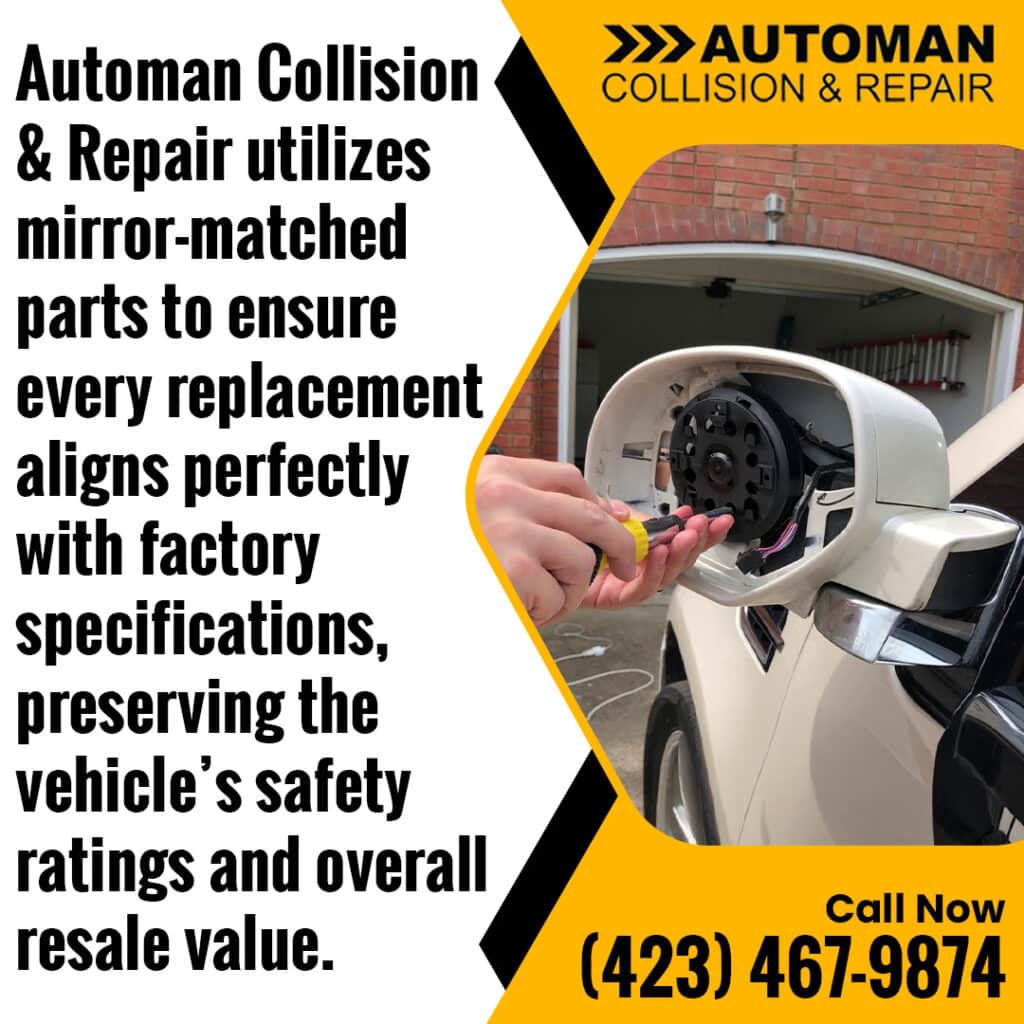
Mirror-matched parts are replacement components manufactured to the same specifications as the parts originally installed on your vehicle at the factory. They replicate the original part’s dimensions, material composition, finish, and fit down to the millimeter.
The term “mirror-matched” refers to the level of precision involved. When a technician installs a mirror-matched part, the replacement aligns with surrounding panels, follows the original body lines, and accepts paint without modification. No gap-filling, bending, or trimming is required.
This matters more than most drivers realize. A poorly fitting replacement panel creates visible seams, uneven gaps between doors and body panels, and paint inconsistencies that buyers and appraisers immediately notice. A structural part that doesn’t fit precisely may also not perform as designed in a future collision, putting occupants at risk.
At Automan Collision & Repair, parts selection is a conversation we have with every customer. As one of the collision repair services Johnson City drivers have trusted for over 30 years, we know that the right part for your vehicle depends on the repair, your car’s age, and your long-term plans for it. When you search for auto body collision shops near you, you want a team that is transparent about parts sourcing and puts your vehicle’s safety and appearance first. That is how we approach every repair that comes through our doors.
Key Takeaways
- OEM (Original Equipment Manufacturer) parts are built to exact factory specifications, producing a precise fit that aftermarket parts cannot always replicate.
- Using mirror-matched parts during collision repair helps preserve your vehicle’s structural integrity, safety performance, and resale value.
- OEM repairs typically preserve 85% to 90% of a vehicle’s pre-accident value, compared to 70% to 75% for repairs using aftermarket parts.
- Certified collision repair shops use mirror-matched parts and color-matching technology to restore a vehicle’s appearance to pre-accident condition.
- Choosing professional collision repair services in Tennessee with OEM-matched components protects both your safety and your long-term investment.
OEM vs. Aftermarket: What’s the Difference?
OEM (Original Equipment Manufacturer) parts are made by the same manufacturer that built your vehicle. Aftermarket parts are produced by third-party companies not affiliated with your vehicle’s brand.
OEM parts are manufactured to exact factory specifications, producing a precise fit every time. They come with manufacturer warranties and maintain the same performance standards as the vehicle’s original components.
Aftermarket parts are not inherently inferior, but quality varies widely. Some meet or exceed OEM standards. Others vary in material composition, fit, and surface finish. For cosmetic repairs on older vehicles, a quality aftermarket part may be a practical choice. For structural repairs, newer vehicles, or any repair involving advanced safety systems, OEM-matched parts are the industry-standard recommendation.
For vehicles equipped with ADAS (Advanced Driver Assistance Systems), such as lane-keep assist or automatic emergency braking, proper calibration and exact fit are critical to maintaining safety performance. The right choice depends on your vehicle, the extent of damage, and your long-term plans.
How Mirror-Matched Parts Affect Vehicle Safety
Collision repairs using mirror-matched structural parts preserve the vehicle’s designed crash performance.
Modern vehicles are engineered with precise crumple zones and safety cages that absorb and redirect crash energy away from occupants. A replacement structural part that doesn’t match the original dimensions can alter how that energy travels through the vehicle.
Most modern cars have safety cages built to withstand head-on collisions, along with crush zones that manage crash energy to reduce forces on the occupant compartment. Replacement structural parts must exactly replicate the original parts to preserve a vehicle’s crashworthiness.
This is why collision repair shops that use mirror-matched OEM parts are the better choice for any repair involving the vehicle’s front end, frame rails, pillars, or rear structure. Structural components carry direct safety implications that cosmetic repairs do not.
The Impact on Resale Value
Repairing collision damage with mirror-matched parts protects your vehicle’s financial value, not just its appearance.
Cars with accident histories can lose 10% to 30% of their value. Using certified repair shops and OEM parts helps preserve resale value. Vehicles with clean history reports sell for 15% to 20% more than those with documented repairs.
Buyers and dealerships use vehicle history reports to evaluate past repairs. A repair performed with correctly fitted, mirror-matched parts shows no visible gaps, paint inconsistencies, or misaligned body lines. It signals to buyers that the vehicle was restored to factory condition.
Non-matched parts create what appraisers call repair-related diminished value. This is the portion of value loss caused directly by the quality of the repair, separate from the inherent loss tied to the accident history. Choosing a collision repair shop that uses mirror-matched parts limits this secondary loss.
What Mirror-Matching Covers: Parts and Paint
Mirror-matching applies to two categories: physical parts and paint finish.
Physical parts include body panels, doors, hoods, fenders, quarter panels, bumpers, and structural components. A mirror-matched body panel follows the exact contour, gauge, and mounting geometry of the original. It installs without modification and aligns cleanly with neighboring panels.
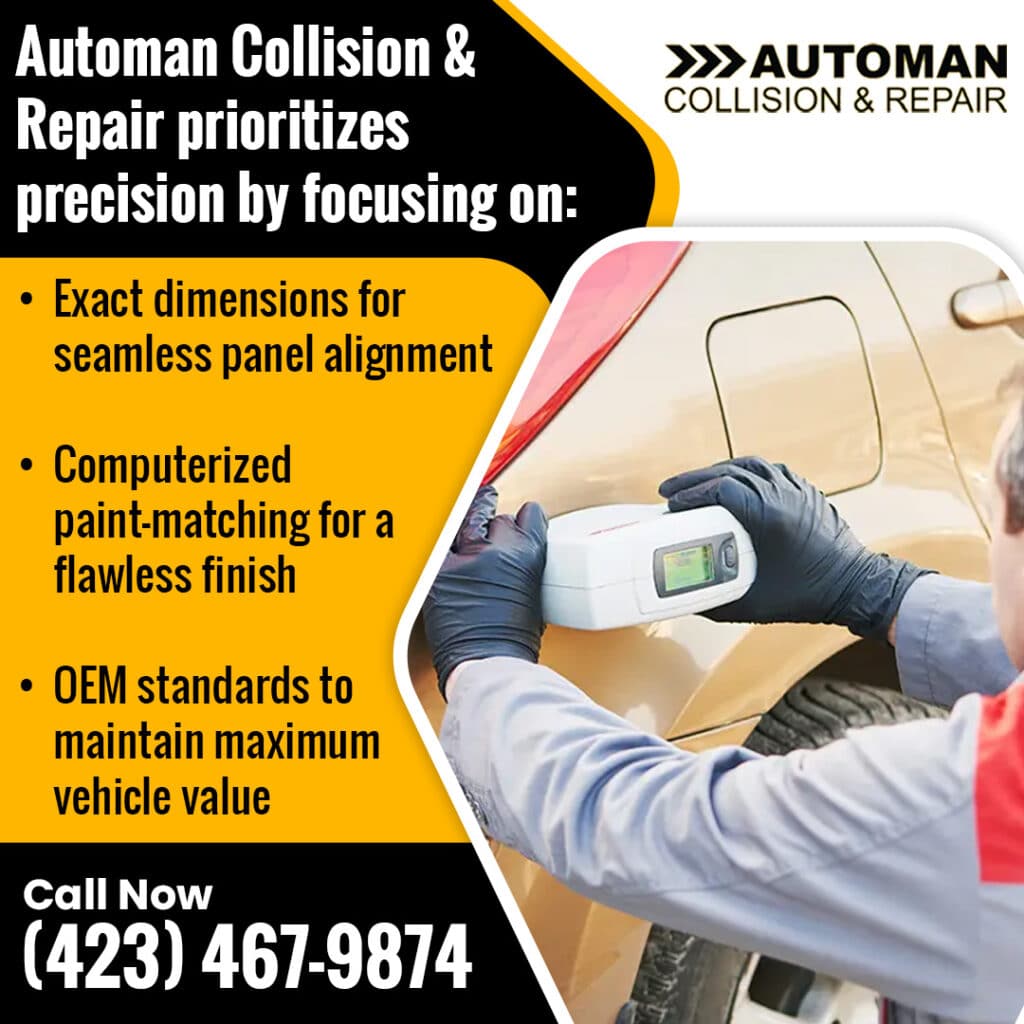
Paint matching is equally important. A repaired panel painted even slightly off-color stands out immediately in natural light, especially on darker or metallic finishes. Professional collision repair shops use computerized paint-matching systems that read the vehicle’s exact color code and account for fading or environmental shifts in the existing paint. The result is a finish that blends with surrounding panels rather than drawing the eye.
The combination of correctly fitted parts and matched paint is what separates a factory-quality repair from a visible patch job.
Part Type vs. Repair Outcome: A Quick Reference
| Parts Type | Value Retained | Value at Risk | Recommended for Structural Repairs |
| OEM / mirror-matched parts | 85% – 90% | 10% – 15% | Yes |
| Aftermarket parts | 70% – 75% | 25% – 30% | Not recommended |
Why Does Fit Matter So Much in Collision Repair?
A part that doesn’t fit precisely creates a chain of problems that compound over time.
An aftermarket panel installed with a slight dimensional mismatch leaves uneven gaps between body panels. Water infiltrates those gaps and accelerates rust formation along the edges of the repaired area. In East Tennessee, where summer humidity and road moisture are recurring factors, damage develops faster than in drier climates. What starts as a hairline gap at the panel edge can become a visible rust line within a single winter season.
Fasteners that don’t seat correctly loosen over time. Misaligned door panels place stress on hinges and latches. A fender that doesn’t follow the original body line creates wind noise at highway speed that no amount of adjustment will fully resolve.
Paint is also affected. A panel that sits slightly proud of its neighbor catches light differently. That difference becomes more visible as the surrounding paint ages and the repaired panel does not match the fade pattern of the original finish. Buyers notice this immediately, and appraisers factor it directly into their valuation.
None of these issues appears immediately. They show up over the following months and years. Mirror-matched parts eliminate this failure chain at the source. When a component fits exactly as the original did, it seals correctly, fastens correctly, and performs correctly for the full service life of the repair.
How to Know If Your Repair Shop Uses Mirror-Matched Parts
Not every auto body shop near you uses mirror-matched OEM parts by default.
Insurance companies often push toward aftermarket alternatives to reduce claim costs. Knowing what to ask protects you. When you bring your vehicle in for an estimate, ask the shop directly:
- Do you use OEM or aftermarket parts for this repair?
- For structural components, will you use parts that match the original manufacturer’s specifications?
- Does the shop hold I-CAR Gold Class Certification, which requires meeting the industry’s highest training and repair standards?
A shop that handles insurance paperwork on your behalf and discloses its parts sourcing upfront is demonstrating the transparency that professional collision repair in Johnson City, TN, should provide. An I-CAR Gold Class certified shop follows manufacturer-approved procedures, not just whatever method is most convenient.
Repair Collision Damage the Right Way in Johnson City, TN
When you bring your vehicle to Automan Collision & Repair, LLC, it is restored using parts and processes that match factory standards. The team has over 30 years of experience performing professional auto body and collision repair in Tennessee, and holds I-CAR Gold Class Certification, the auto body repair industry’s highest training standard.
Automan is a locally and family-owned auto body shop in Johnson City, TN, recognized as a Reader’s Choice Award Winner for quality and customer satisfaction. They work with all insurance providers, handle the paperwork, and offer free no-obligation estimates before any work begins. Your vehicle doesn’t leave until the repair meets their standards.
Whether you need to repair collision damage from a fender bender or a more significant impact, Automan Collision & Repair has the equipment, training, and commitment to restore your vehicle to factory condition.
Here’s what our clients say:
“Nobody likes to have to go to a collision repair shop. However, Automan made it easy and stress-free. Their office staff is professional and courteous. Always helpful and will answer all questions. The work done on my car was exceptional! So good… that I went right back to them a year later when a mechanic at Walmart damaged my car during service. Automan will always be my go-to for vehicle repair.” – Victoria E.
“James did a great job taking care of me when I hit a curb and bent my wheel! I would highly recommend his company if you have any collision repair needs!” – Joshua D.
Call (423) 467-9874 or email [email protected] to schedule your free estimate. Serving Johnson City and nearby areas across the Tri-Cities region of Tennessee.