
Your car’s safety systems may fail after a collision, even when repairs appear flawless. Most drivers discover this only when it’s too late.
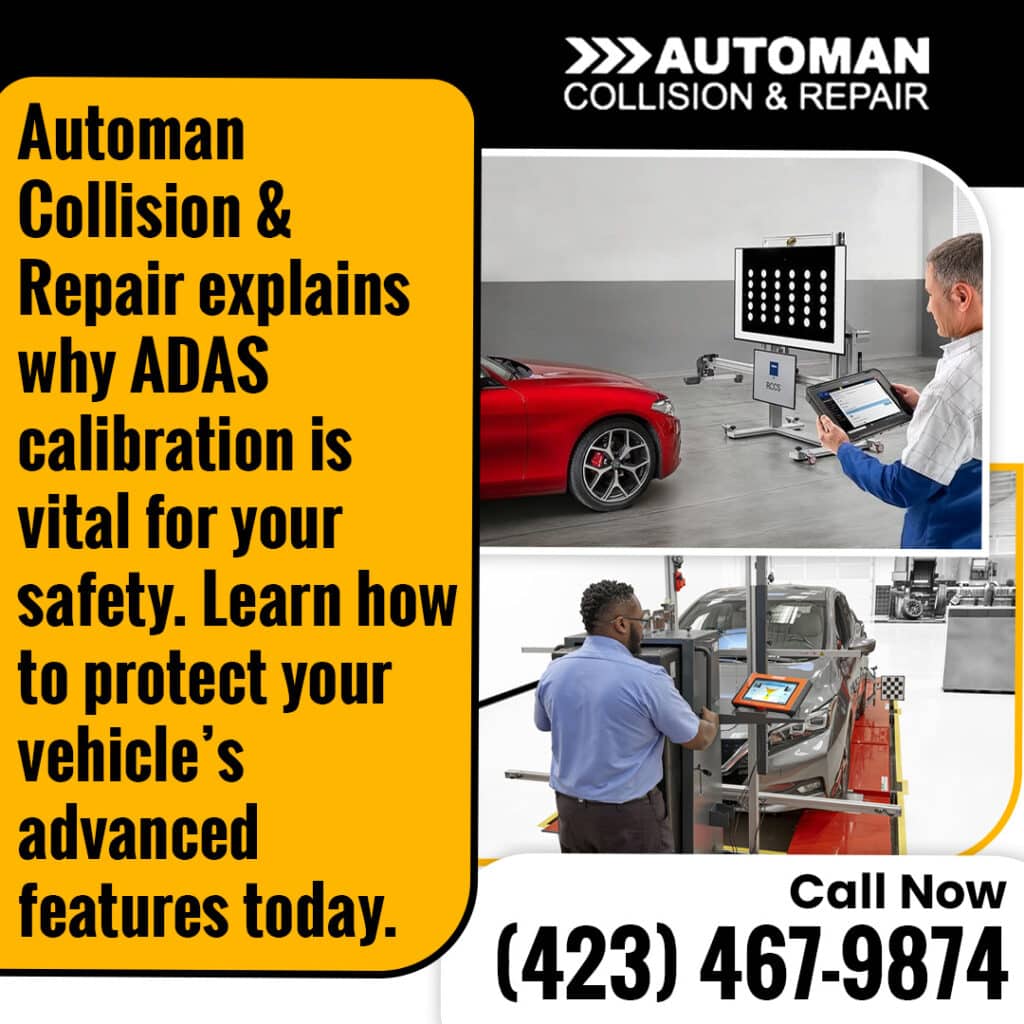
ADAS (Advanced Driver Assistance Systems) includes the cameras, radar sensors, and software that power features like automatic emergency braking, blind spot monitoring, and lane departure warnings. These systems keep you safe on the road. But after a crash, they often need to be recalibrated to work correctly again.
At Automan Collision & Repair, our local auto body repair team in Johnson City, TN sees this confusion every week. Drivers leave the body shop thinking their car is fully fixed. But without proper ADAS calibration, those safety systems may be off or completely offline.
Here are the most common myths about ADAS after a crash, and the facts you need to know.
Key Takeaways
- ADAS systems need recalibration after most collision repairs, even minor ones.
- No warning light does not mean the system is working correctly.
- Insurance usually covers ADAS calibration when it’s part of a collision claim.
- Any auto body shop near you should be checking for calibration needs, not just dealerships.
- Skipping calibration can make your safety systems unreliable or completely inactive.
Why ADAS Matters More Than Ever
ADAS technology is now standard on most new vehicles, and it is actively preventing crashes on roads across the country.
The National Safety Council estimates that current ADAS technologies have the potential to prevent around 62% of traffic deaths and roughly 60% of crash injuries annually if widely used. That is not a small number. These systems are changing road safety in a real, measurable way.
Vehicles equipped with forward collision warning and automatic emergency braking are involved in about 50% fewer rear-end collisions compared to similar models without those features, according to the Insurance Institute for Highway Safety (IIHS). Lane departure warnings reduce crashes by around 7%. Blind spot monitoring helps prevent unsafe lane changes that drivers may not catch on their own.
By 2029, eight different ADAS features will be present in half or more of all registered vehicles in the United States, according to the Highway Loss Data Institute. That means the majority of cars on Tennessee roads will depend on these systems to function correctly every single day.
For drivers in Johnson City, that shift is already happening. Local auto body shops that don’t account for ADAS in their repair process are missing a critical part of what makes a vehicle safe to drive.
At Automan Collision & Repair, local auto body repair in Johnson City is built around the full picture, not just what you can see. Restoring your vehicle means restoring every system inside it.
Myth #1: “My Car Looks Fine, So the ADAS Must Be Fine Too”
False. ADAS sensors are affected by much more than visible damage.
A bumper repainted perfectly can still house a radar sensor that’s pointing in the wrong direction. A replaced windshield can knock a forward-facing camera out of alignment. None of this shows up in how the car looks.
Industry professionals conducted tests on a 2024 Nissan Altima, evaluating its performance under various ADAS calibration scenarios. When the lane departure warning was not calibrated after simulated repairs, the system failed. Poor calibration caused inconsistent braking distances and system errors, with no obvious warning to the driver.
Your car’s appearance tells you nothing about whether the ADAS is working.
Myth #2: “If There’s No Warning Light, the System Is Fine”
Not true. ADAS sensors can be misaligned without triggering a dashboard alert.
This is one of the most dangerous myths in collision repair today. A sensor can be slightly off-angle and still pass a basic scan without any fault codes. It functions, just not accurately. That means your automatic braking might respond more slowly than it should. Your blind spot monitor might miss a vehicle in the next lane.
You won’t know until you need the system most.
The only way to confirm ADAS is working correctly is a proper post-repair calibration performed to OEM (original equipment manufacturer) standards.
Myth #3: “Only Dealerships Can Calibrate ADAS”
False. A certified auto body repair shop can perform ADAS calibration.
Many drivers assume that ADAS calibration requires a dealership visit. This is not accurate. A qualified local auto body shop in Johnson City with the right equipment and training can handle calibrations properly.
Automan Collision & Repair is I-CAR Gold Class Certified. I-CAR (Inter-Industry Conference on Auto Collision Repair) sets the industry’s highest training standards for collision technicians. That certification means our team is trained to identify and perform ADAS calibrations as part of the repair process, not as an afterthought.
When you bring your vehicle to our auto body shop in Johnson City, TN, calibration is part of how we check your car before it leaves.
Myth #4: “ADAS Calibration Only Matters After a Major Crash”
False. Even minor collisions can throw ADAS sensors out of alignment.
A fender bender at 15 mph can be enough to shift a bumper-mounted radar sensor. A windshield replacement on a modern vehicle almost always requires recalibration of the forward-facing camera.
The data backs this up.
Stat: As of Q2 2025, 65% of collision repairs required ADAS calibration, up from 53% just two quarters earlier, according to market research.
That number applies to all collision repairs, not just severe ones. If your car was built in the last 10 years, it almost certainly has ADAS technology that needs attention after any bodywork.
Myth #5: “My Insurance Won’t Cover ADAS Calibration”
In most cases, it does – when the calibration is part of a covered collision claim.
Automan Collision & Repair works with all major insurance providers. We handle the paperwork so you don’t have to. If calibration is required as part of your repair, we document it and include it in your claim.
The bigger financial risk is skipping calibration. ADAS-related lawsuits grew from 3 cases in 2018 to 61 cases in 2024, according to repair specialists. The average settlement in these cases ranges from $200,000 to over $1 million.
Proper calibration protects you, and your insurance handles it.
Which ADAS Systems Need Calibration After a Repair?
This table shows the most common ADAS features and when calibration is typically needed.
| ADAS System | When Calibration Is Needed |
| Automatic Emergency Braking (AEB) | After a front-end collision or bumper repair |
| Lane Departure Warning (LDW) | After windshield replacement or front-end repair |
| Blind Spot Monitoring | After rear bumper repair or side collision |
| Adaptive Cruise Control (ACC) | After the front radar sensor area is disturbed |
| Rear Cross Traffic Alert | After rear bumper removal or repair |
| Forward Collision Warning (FCW) | After any front-end damage or sensor work |
Every vehicle is different. The type of repair, the make of your vehicle, and the model year all affect which systems need recalibration. A proper pre- and post-repair scan at a qualified auto body repair shop tells you exactly what’s needed.
What Happens If ADAS Is Not Calibrated?
The consequences range from minor inconvenience to serious safety risk.
A lane departure system that isn’t calibrated may give constant false alerts, or stop warning you altogether. Automatic emergency braking with a misaligned radar sensor may not stop in time, or may brake when there’s nothing in front of you. Blind spot monitoring may fail to detect a vehicle in the adjacent lane.
These aren’t hypothetical problems. Market research shows that skipping calibration after a repair caused complete system failure in some cases, and erratic, unreliable performance in others. The systems appeared to be running. They just weren’t working.
At any local auto body shop you trust, this should be part of the conversation when you drop off your car.
Why Local Auto Body Repair in Johnson City Matters Here
Choosing the right shop for auto body repair in Johnson City, TN, means choosing one that handles the full repair, not just the visible damage.
Automan Collision & Repair has served the Johnson City area for over 30 years. We are locally owned, family operated, and I-CAR Gold Class Certified. Our team uses advanced equipment to restore your vehicle to pre-collision condition, which includes identifying and performing required ADAS calibrations.
We were recognized as a Reader’s Choice Award Winner, a reflection of the trust our community places in our work.
Whether you found us searching for a body shop near you or were referred by a neighbor, you’ll get the same commitment: your car doesn’t leave until the job is done right.
What Our Customers Say
“From start to finish, Automan Collision & Repair was very professional. James was very helpful in answering all my questions. I was very pleased with my windshield replacement. I will use them in the future for all my auto repair needs. Give them a call! You will not regret it.” – Tonya H.
“Automan Collision and Repair is a dependable business that delivers quality workmanship and excellent customer service. They are professional, efficient, and clearly dedicated to making sure repairs are handled properly. Their commitment to customer satisfaction and attention to detail truly set them apart.” – K. Duncan
Your ADAS System May Not Be Working–Even If Everything Looks Fine
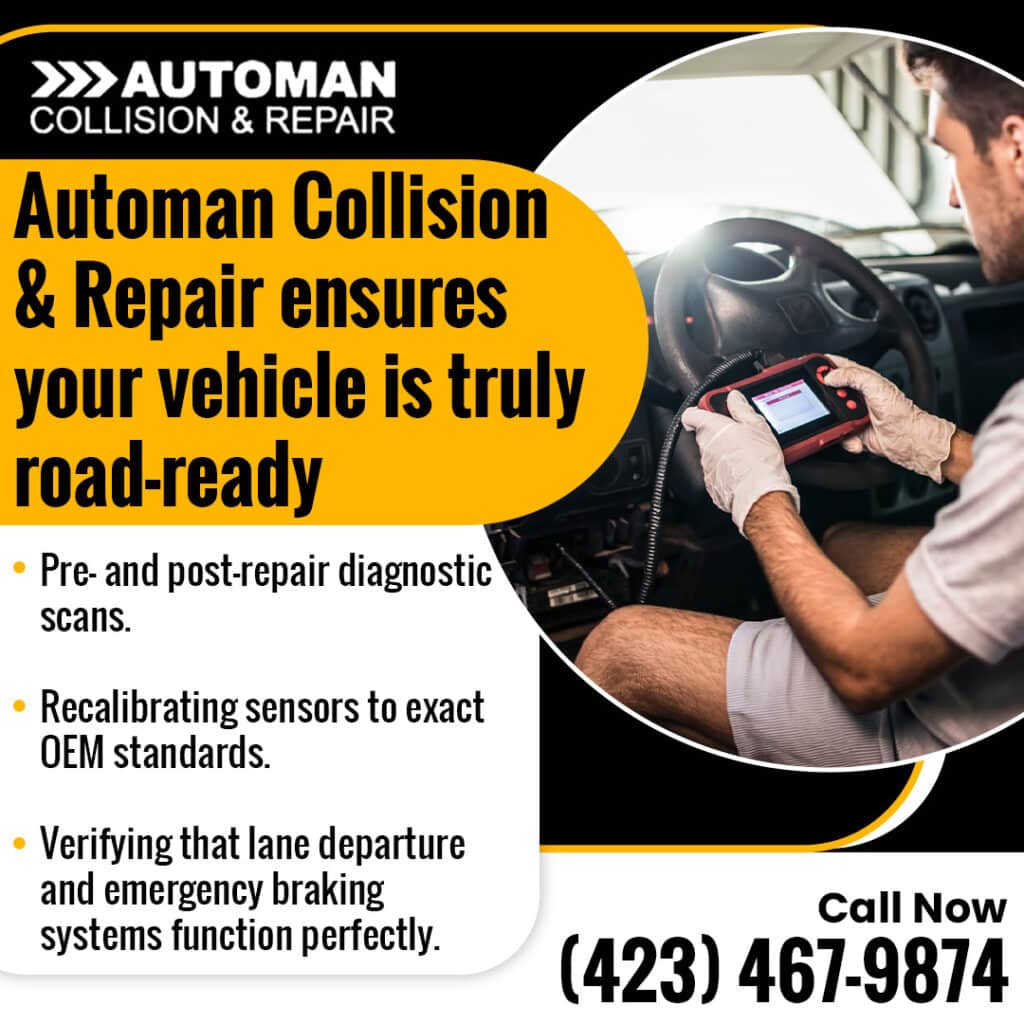
After a collision, your vehicle’s safety systems need the same attention as visible damage. No warning light on your dashboard doesn’t mean your automatic braking, lane departure warnings, or blind spot monitoring are functioning correctly.
Without proper ADAS calibration, you may be driving with safety systems that appear active but aren’t performing as designed. That puts you and your passengers at risk every time you’re on the road.
Automan Collision & Repair LLC provides complete post-collision assessments that include ADAS evaluation and calibration as part of the repair process—not as an afterthought. Our I-CAR Gold-Class certified technicians identify calibration needs during the initial damage inspection and handle coordination with your insurance provider.
If your vehicle has been in any collision—even a minor one—schedule a comprehensive damage assessment with Automan Collision & Repair LLC at 114 Industrial Rd, Johnson City, TN 37615, by calling (423) 467-9874 or emailing [email protected] for complete collision repair and ADAS calibration services throughout Johnson City and Northeast Tennessee.